The quick version
- Cabo Girão rises 580 metres above the Atlantic on Madeira's south coast, a sheer wall of volcanic rock with farmland at its feet.[1]
- A glass platform cantilevered over the drop, completed in October 2012 and open daily from 08:00 to 20:00.[1][2]
- There is an entrance fee of €2, except for residents and children up to 12 years old.[1]
- The Teleférico do Rancho cable car reaches the fertile fields of the Fajã do Cabo Girão below the cliff; a return trip costs 10 euros.[3][4]
- The Madeira: Skywalk, Porto Moniz, Seixal, and Fanal 4WD Tour runs for 8 hours with pickup, from US$79.[5]
- Top choice Skywalk, Seixal and Fanal from US$79 Duration8 hours[5]Group sizePrivate or small groups available[5]CancellationFree cancellation up to 24 hours before[5]Ratingrated 4.87 from 9,297 reviews[5] Check availability
- Enchanted Terraces 4WD from US$80 Duration8 hours[6]Group sizePrivate or small groups available[6]CancellationFree cancellation up to 24 hours before[6]Ratingrated 4.78 from 5,647 reviews[6] See this tour
- West Waterfalls and Fanal from US$40 Duration8 hours[7]Group sizePrivate or small groups available[7]CancellationFree cancellation up to 24 hours before[7]Ratingrated 4.70 from 3,827 reviews[7] See this tour
Estrada do Cabo Girão | 9300-351 Câmara de Lobos Daily:08:00-20:00
Is the Cabo Girão skywalk worth the stop?
Know before you leave
How Madeira's Volcanic Cliffs Rose From the Ocean
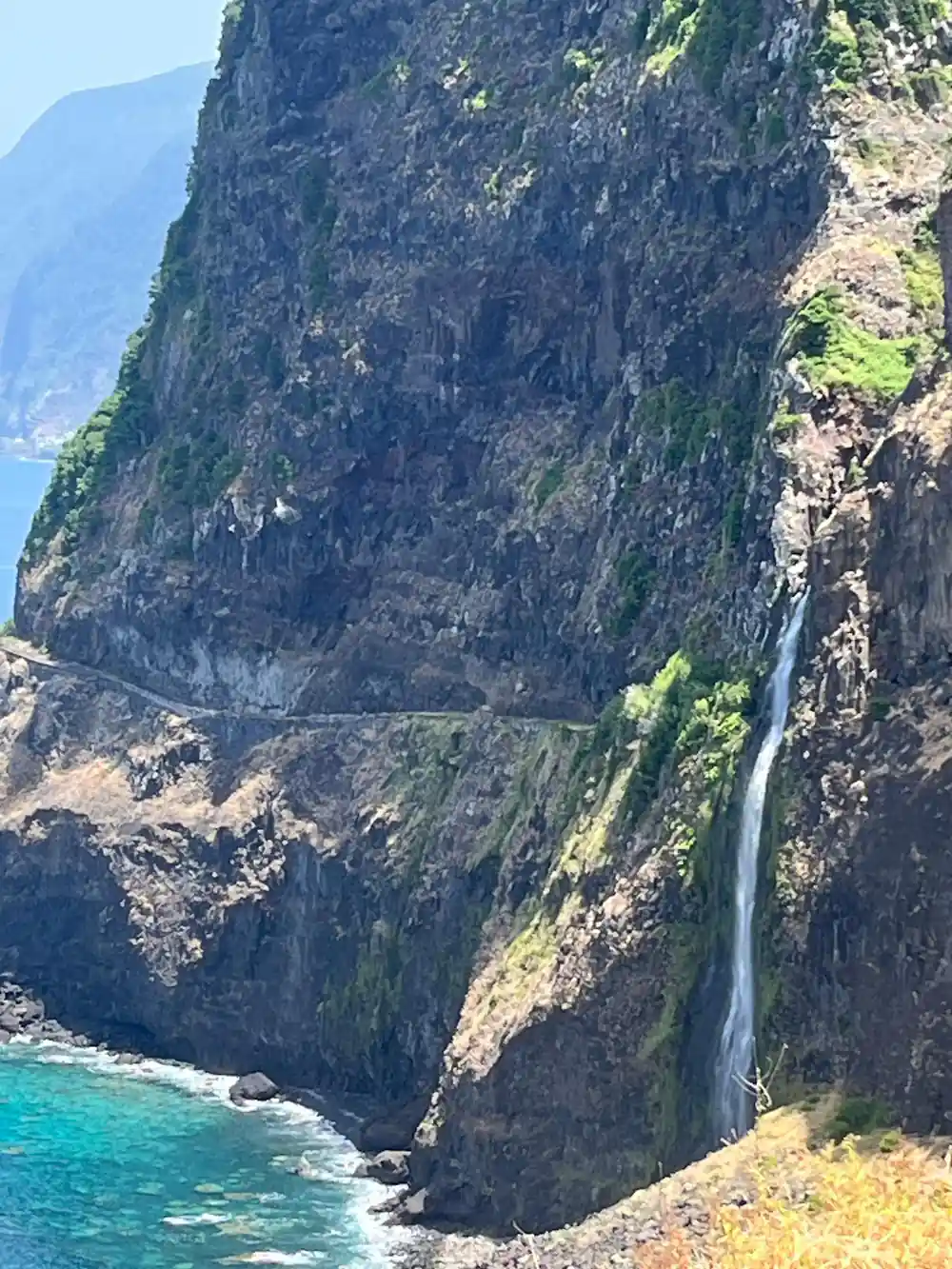
Madeira is the top of a shield volcano, built up over a very long time by lava that cooled into dark basalt and was then covered again and again by fresh flows. Where that rock meets the Atlantic, waves and rain have been cutting for just as long. The result is an island with almost no gentle coast: the land tilts, then falls, and the south coast falls hardest of all, leaving a wall of rock that runs from the sea spray up into the cloud.
Cabo Girão is the tallest expression of that wall on the south coast. The headland rises 580 metres above the water,[1] and the rock face below it is sheer enough that the ocean looks almost flat from the top. From the sea the cliff reads as a curtain; from the road it is a landmark you spot long before you reach it. Either way, the Cabo Girão cliff is the reason drivers keep heading west past Câmara de Lobos on their first clear day.
The rock underfoot is mostly basalt and volcanic ash, stacked in flows that are easy to read in the cliff face. Look across at the layers and you can see how the island grew, one eruption on top of another, with long quiet gaps in between when soil and forest formed over the lava.
Building the Skywalk into Solid Rock
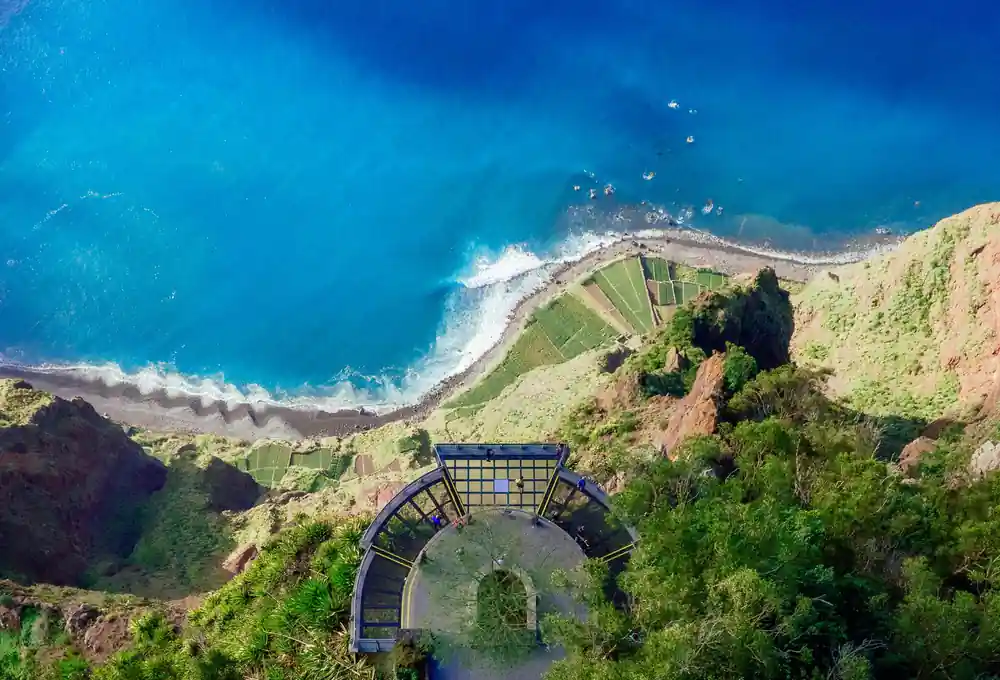
The famous glass platform is a simple idea executed with a great deal of engineering. Steel and glass are anchored into the rock so that you can step out beyond the edge and stand with nothing under your feet but air and, far below, the Atlantic. From the car park it looks modest; the moment you walk to the far rail, it does not. The platform is small, and that is part of its charm: a handful of steps, a rail, and then a very long way down.
The Cabo Girão Skywalk was completed in October 2012.[2] It is open daily from 08:00 to 20:00.[1] There is an entrance fee of €2, except for residents and children up to 12 years old.[1] Just beside the viewpoint, the Teleférico do Rancho cable car heads down the cliff towards the fields on the shelf of land below, which makes the skywalk easy to pair with a wander among the crops.
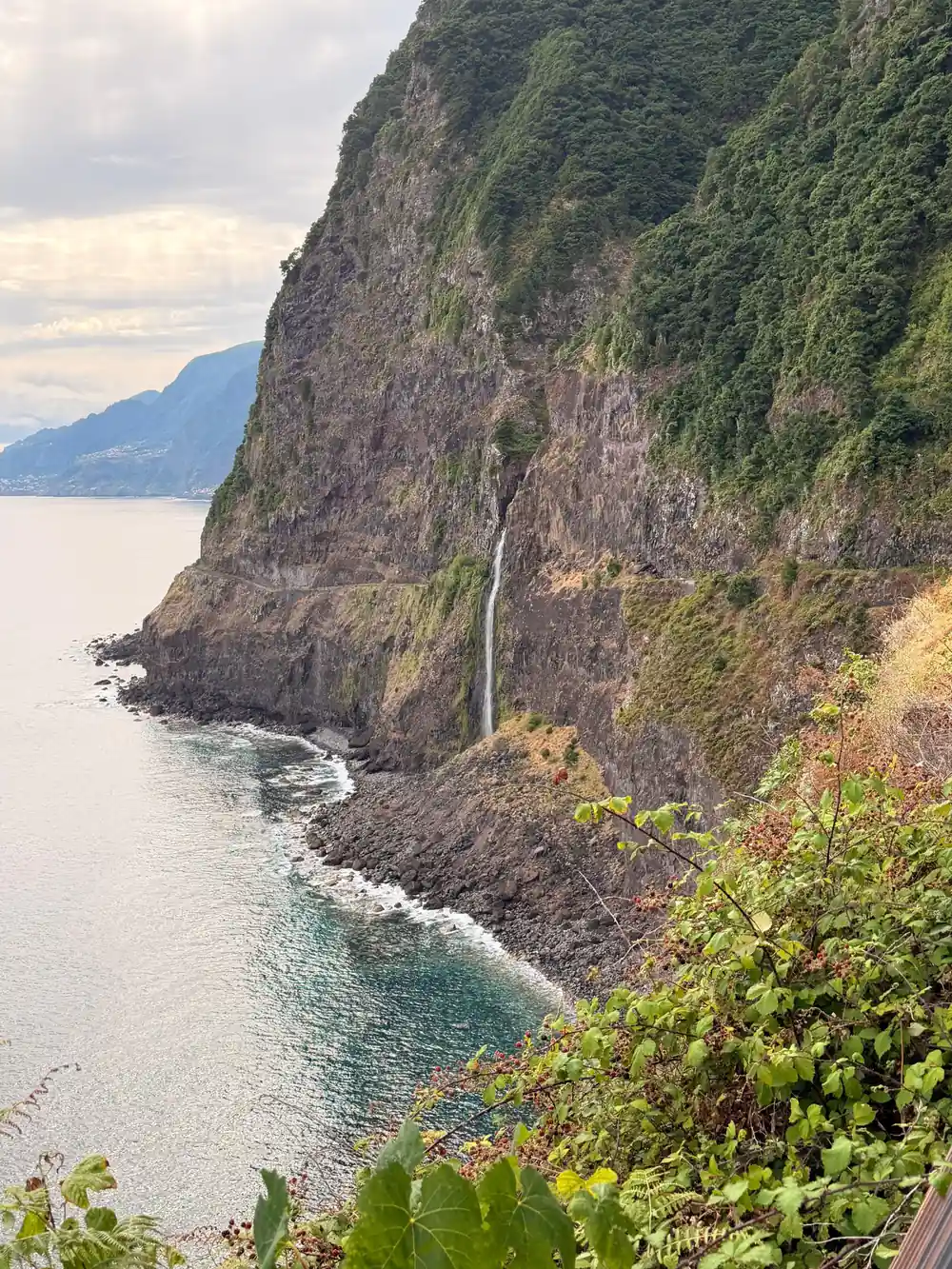
Turquoise water and black rock below Madeira's north coast cliffs.
The Name Girão and the Town Below
Câmara de Lobos sits on the coast just along from the cliff, a town wrapped around a small bay of fishing boats, painted doors and steep streets. Its bay was painted by Winston Churchill, who set up his easel at the Espírito Santo Viewpoint facing the sea in January 1950.[9] The harbour is still a working one, and the fish landed there turns up on dinner plates in Funchal and beyond.
The headland and the town share the same stretch of coast, and walkers know it well. The Levada do Norte walk runs from Estreito de Câmara de Lobos to Cabo Girão,[10] following an irrigation channel through vineyards and terraced fields before it arrives at the cliff. It is a gentle way to earn the view: you spend the morning at the level of the crops and finish where the ground simply stops.
Farmers, Vineyards and the Fajãs Below
Below the viewpoint there is a narrow shelf of farmland, one of the fajãs, the flat pockets of ground that sit between cliff and sea. The Fajã do Cabo Girão is known for the impressive fertility of its agricultural land, and this narrow, lush piece of land can be accessed by cable car.[3] A return trip on the Teleférico do Rancho cable car costs 10 euros.[4]
Down there the plots are small and worked by hand: vines, bananas, vegetables and flowers on ground that has been terraced and tended over many generations. The cable car makes the descent straightforward, but this is a working landscape rather than a beach resort, so walk quietly, keep to the paths and leave gates as you find them.
Look up from the fields and the cliff is a different thing entirely, a grey and green wall that fills the sky, with the skywalk a small glass splinter on the top. Vines and banana plants grow in the shadow of a rock face that keeps the sun off for part of the day, and the sound of the sea is always there. It is the kind of view that makes the ride back up feel like a fair exchange.
from US$79
The Madeira: Skywalk, Porto Moniz, Seixal, and Fanal 4WD Tour, the trip booked from this site, runs for 8 hours.[5]
What You Can See From the Top
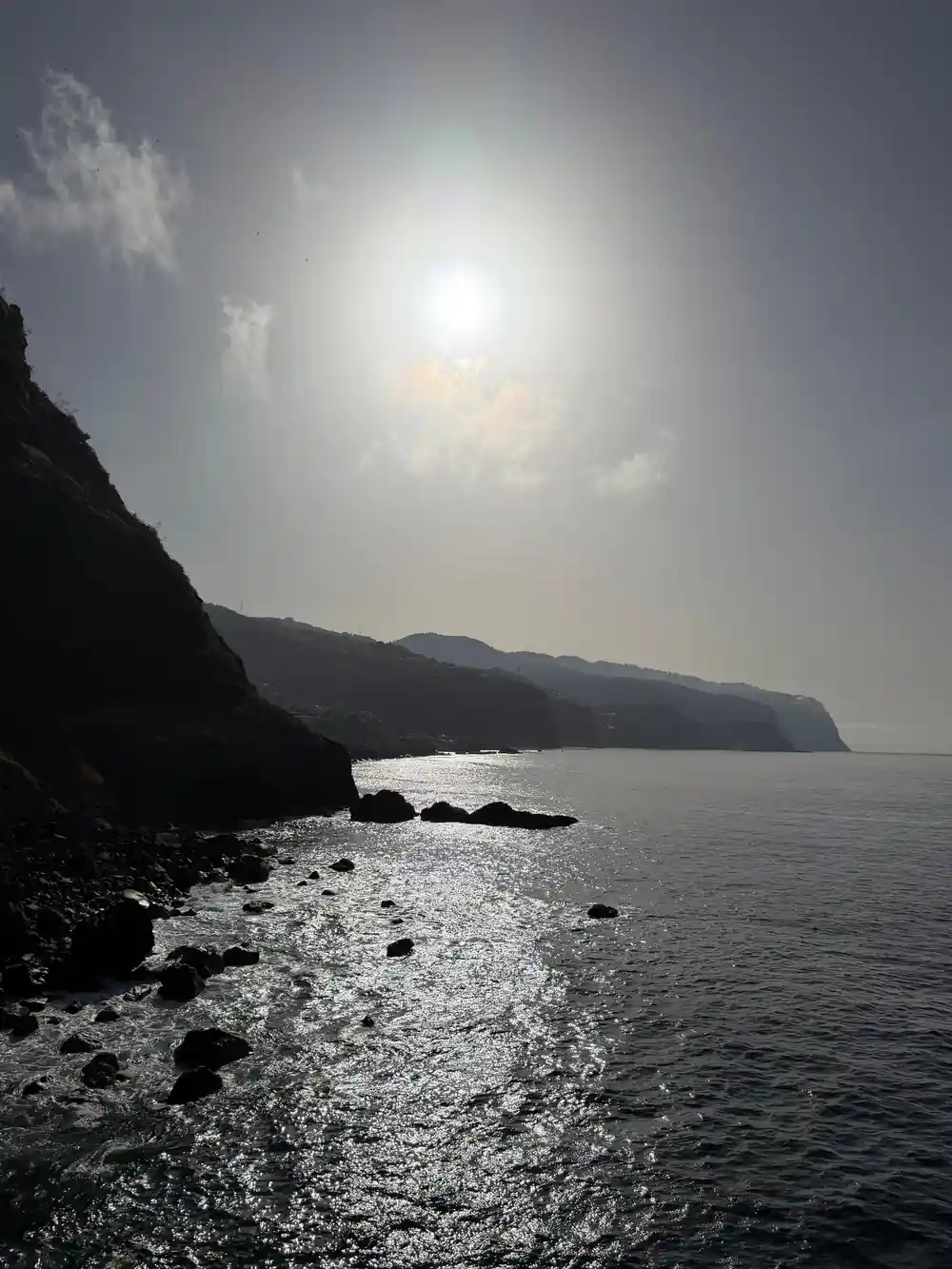
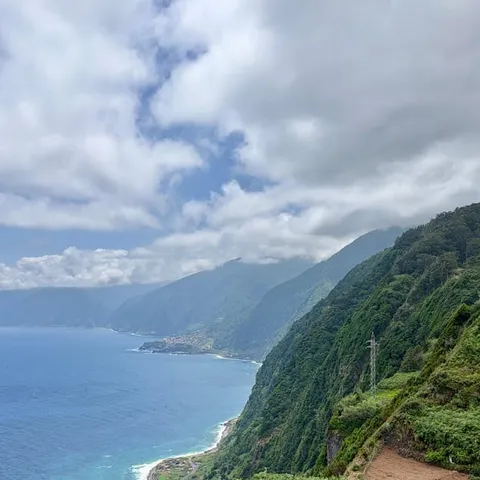
From the platform the view runs east along the south coast: the curve of the shoreline, the harbour and houses of Câmara de Lobos, terraced slopes stepping down to the water, and the spread of Funchal roughly 15 kilometres away.[11] Westward the cliffs carry on past Ribeira Brava towards the high ground, and directly below, the fields of the fajã look like a patchwork quilt stitched onto the rock.
On a clear day you can watch the light move across the water, see the shadow of clouds sliding over the terraces and pick out the thin line of the coastal road. Cloud often gathers on the north side of the island while the south stays bright, which is worth remembering when you are deciding where to spend an afternoon.
Further round the coast at Santana, the Guindaste Viewpoint sits on one of the slopes of the Foz da Ribeira do Faial and offers a view over the north coast of Madeira,[12] which is a reminder that on this island the drama is not confined to one headland.
Why Cabo Girão Matters to Madeira
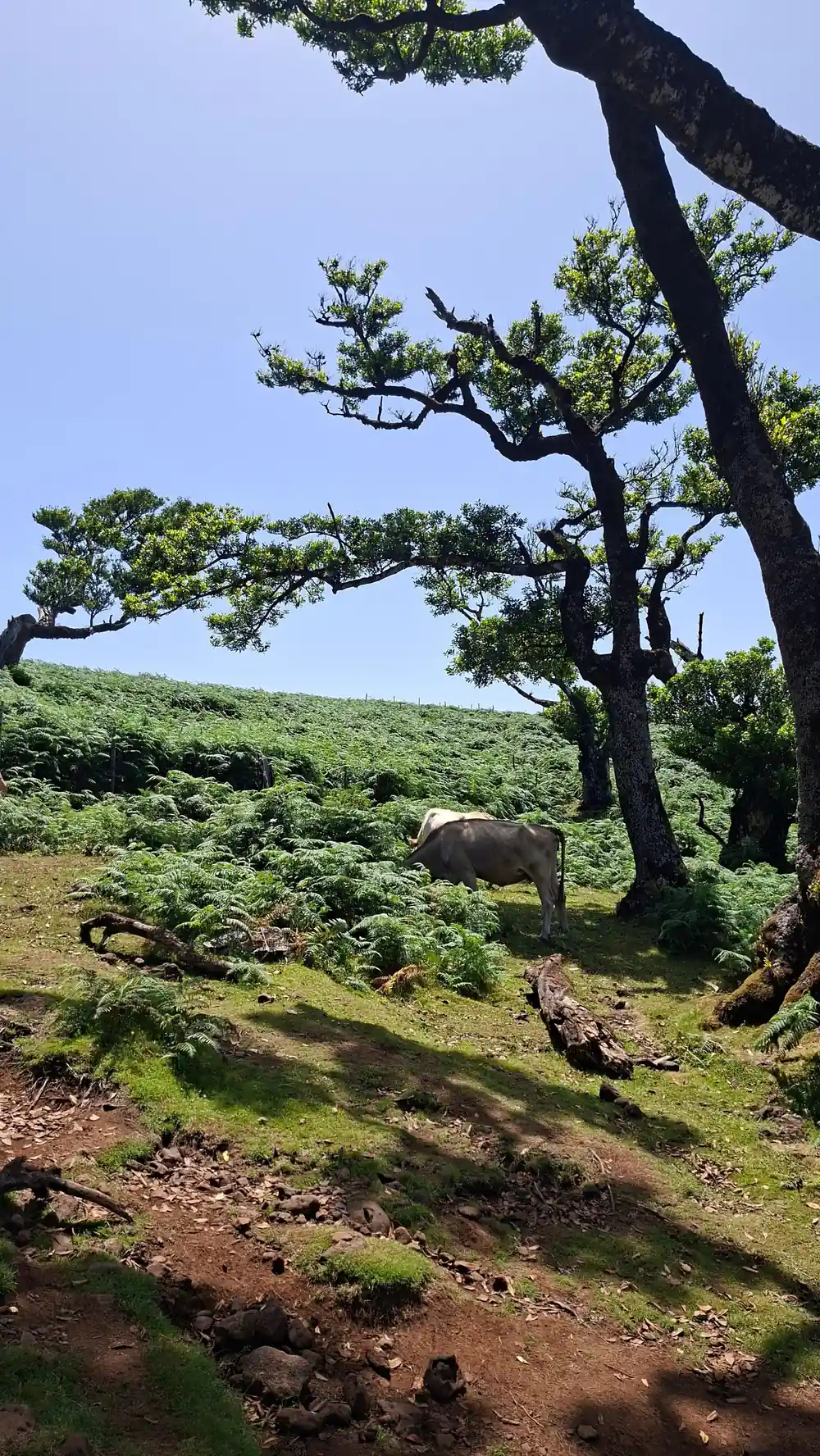
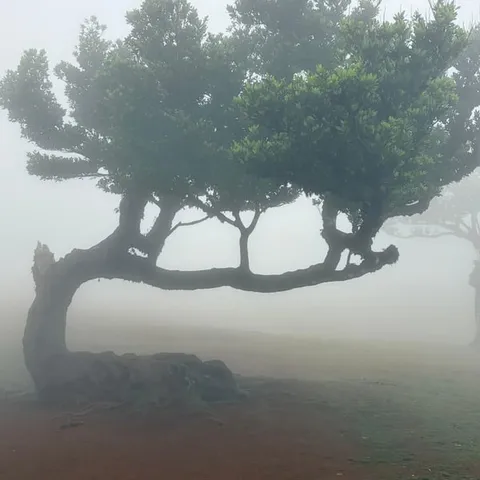
Madeira's laurel forest, the Laurissilva, has been a UNESCO World Heritage Site since 1999.[13] Fanal is presented by the island's tourism board as a mystical, century-old forest to discover.[13] Both belong to the wet, green side of an island that many people picture as cliffs and sunshine, and both are within reach of the same day out that takes in the skywalk.
The cliff is a landmark in the everyday sense too: a place people drive to on a Sunday, a reference point for the weather, and the spot where the island's steepness becomes obvious in a single step. Standing at the rail, you are looking at the same rock that made the beaches, the terraces and the levadas possible, on an island where the land has nowhere to go but up or into the sea. People come here for a photograph and a look at the drop, and they leave with a clearer sense of how this island was made.
Planning Your Visit to the Skywalk
The skywalk sits beside the road at Cabo Girão, with parking next to it, and it is open daily from 08:00 to 20:00.[1] There is an entrance fee of €2, except for residents and children up to 12 years old.[1] Madeira has a subtropical Mediterranean climate with even temperatures all year round and an average annual temperature of 20°C (67°F),[8] so the viewpoint works in any season.
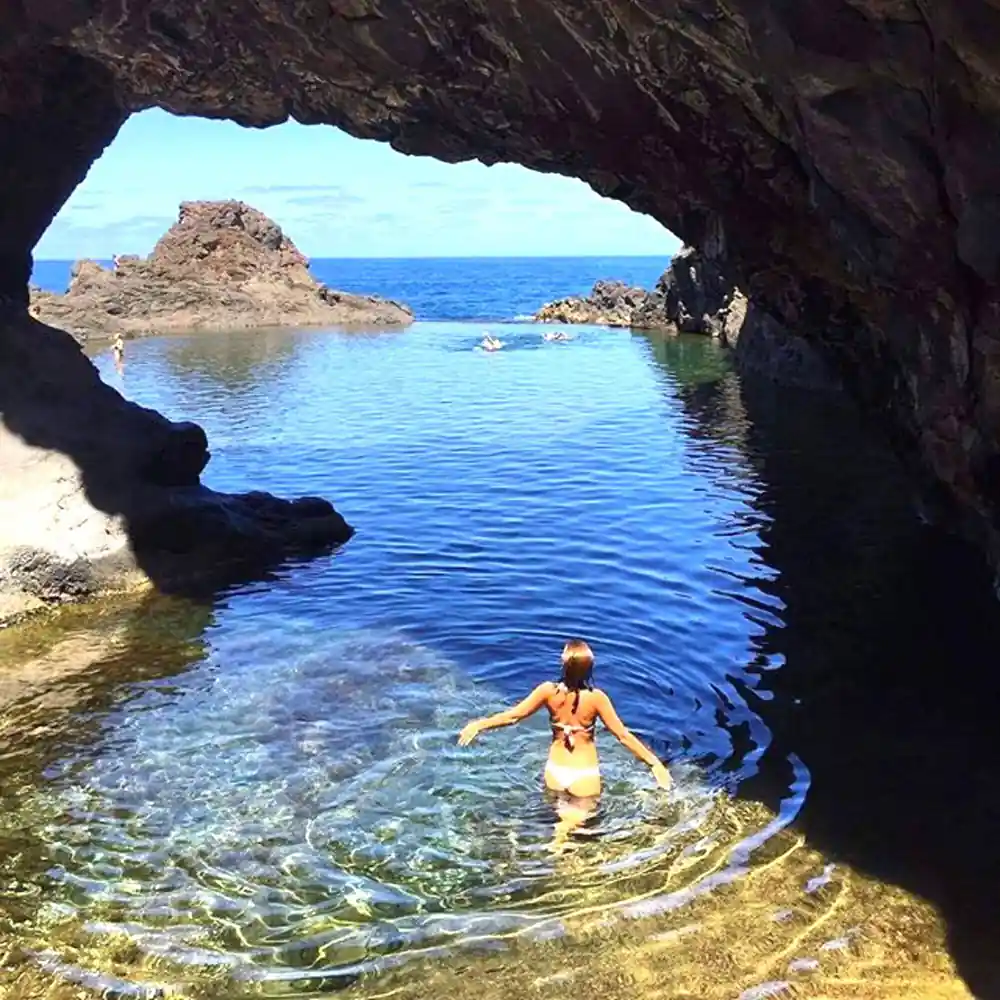
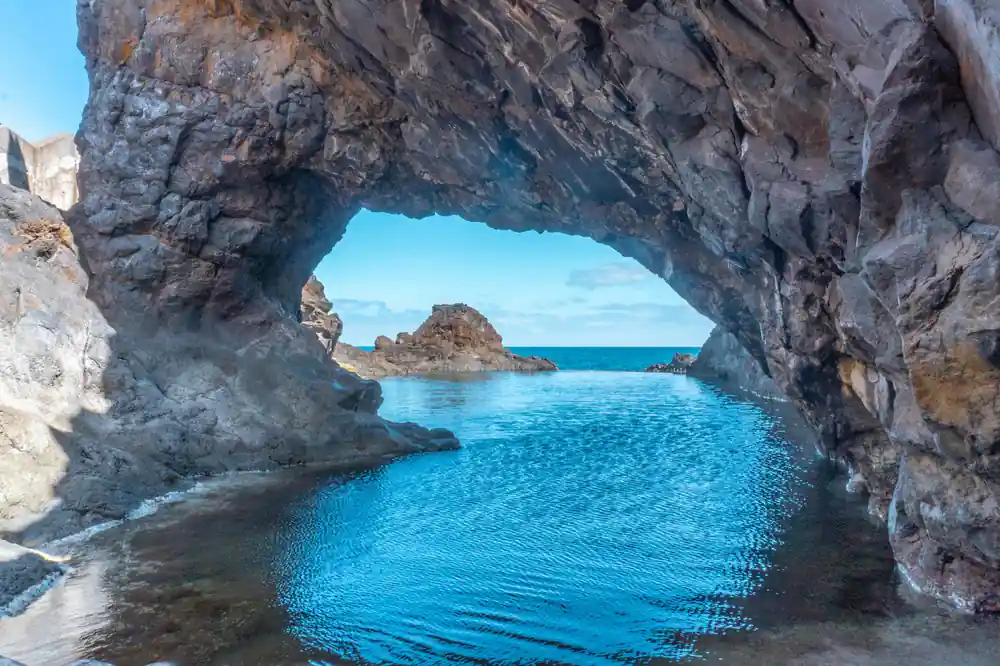
If you would rather see the whole west of the island in one day, the Madeira: Skywalk, Porto Moniz, Seixal, and Fanal 4WD Tour, booked from this site, runs for 8 hours with pickup included and a live guide.[5] It takes in the skywalk, the north coast villages, the natural pools at Porto Moniz and the forest at Fanal. Those pools have a swimming area of 3,800 m2 that is 2 metres deep, holding around 7,600 m3 of seawater, plus a lounging area of approximately 3,217 m2.[14]
Bring a swimsuit and a towel for the pools, and a layer for the forest, where cloud and cool air are part of the experience. The skywalk itself is a short stop rather than a whole day, so it works best as one piece of a longer west coast plan, and free cancellation on the tour runs up to 24 hours in advance for a full refund.[5]
West Madeira tour prices, from
Compare west Madeira tour from-prices
Adult from-prices in US dollars for these listings:[5][6][7][15]
When to go and when to book
Plan your Cabo Girão day
Check the weather
The south coast is often sunny when the north is in cloud, so look at both sides of the island before you set off.
Decide on the cable car
A return trip on the Teleférico do Rancho costs 10 euros and takes you down to the fertile fields below the cliff.[3][4]
Time your stop
Cabo Girão is open daily from 08:00 to 20:00, and the skywalk itself is a short visit rather than a half day.[1]
Add the west coast
The 4WD tour from this site runs 8 hours, from US$79, and covers the skywalk, Porto Moniz, Seixal and Fanal.[5]
Book with flexibility
Free cancellation up to 24 hours in advance for a full refund, and you can reserve now and pay later.[5]
Ride the west coast in a 4WD, from the skywalk to Fanal
from US$80Reserve now & pay later